

Our Commitment
For more than 35 years, Elliott Sandblasting has been a trusted family name in surface preparation and protective coatings.
What began as a father & son operation in Labrador has grown into a business known for mastery, reliability, and results that stand the test of time.
Brett's reputation has been built the same way he treats every job — with precision, pride, and an uncompromising commitment to quality.
Decades in the industry have taught us the value of doing things right the first time, and that experience is visible in every surface we restore and every finish we deliver.
From industrial steelwork to concrete, timber, machinery, and architectural projects, we bring deep technical knowledge and genuine craftsmanship to every blast.
When you choose Elliott Sandblasting, you’re choosing a team backed by generations of skill, proven methods, and a standard of excellence you can see in every finish.
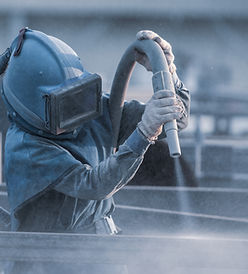

What is Abrasive Blasting?
Abrasive sandblasting works by firing compressed air and abrasive media at extreme speed — our 400+ CFM compressors push garnet or crushed glass media through large, handheld, blast hoses, at over 500 km/h.
That high‑velocity stream hits the steel hard enough to strip rust, paint, and mill scale, clean it to the required class (Sa 1–Sa 3), and create the ideal surface profile for coatings to actually stick.
It’s the combo of speed + abrasive impact that makes blasting unbeatable.
The air brings the muscle, the media does the cutting, and together they reach pits, welds, and awkward shapes that sanders and grinders can only dream about.
The result? A clean, uniform surface ready for high‑performance primers and coatings — no swirl marks, no patchy prep, just steel that’s properly prepared and won’t embarrass your paint system later.


Abrasive Blasting Profiles
A blasting 'profile' is the tiny peaks and valleys created when abrasive hits the steel — measured in microns or mils.
Different coatings need different profiles and paired with the right Class (Sa 1–Sa 3), they decide whether your coating lasts… or taps out early in Queensland’s lovely “steel‑eating” climate.
Cleanliness matters: coatings only stick to clean metal. Rust, mill scale, and old paint don’t just get in the way — they actively sabotage adhesion.
Critical jobs like marine, mining, and industrial work need higher classes to survive.
Blasting doesn’t just clean; it builds a controlled texture that coatings can actually grip.
We'll blast to the spec profile, so your coating system performs properly and doesn’t embarrass itself later.
Class 2 Blast
Commercial Blast
-
Removes most rust, paint, and scale.
-
Some staining is still allowed.
-
Metal colour starts to show through.
Class 2.5 Blast
Near-White Metal Blast
-
Removes almost all rust, paint, and contaminants.
-
Only very light shadows or slight stains remain.
-
This is the most commonly specified level for protective coatings.
Class 3 Blast
White Metal Blast
-
Removes all rust, paint, scale, and contamination.
-
Surface looks bright, clean, and uniform.
-
Highest and cleanest standard — used for critical coatings.


Steel & Aluminium
We blast steel because coatings don’t stick to rust, grime, or wishful thinking — a clean, profiled surface is the only way to guarantee long‑term protection.
Industrial sandblasting is essential before:
-
welding
-
NDT inspections
-
epoxy/2K coating systems
-
zinc primers
-
polyurethane topcoats
It creates a consistent, uniform surface profile that meets engineering and coating specifications.
Industrial sandblasting is not optional — it is mandatory for any industry that relies on steel, coatings, or structural integrity. It ensures adhesion, prevents corrosion, improves safety, and extends asset life. Without proper blasting, even the best coating systems will fail prematurely.
The Importance
of Removing Mill Scale
Why We Blast Mill Scale (and Its Flux Friends) Off — Every Time
Mill scale isn’t just a cosmetic layer — it’s a brittle, contaminated by‑product of the hot‑rolling process. During rolling, steel is exposed to extreme heat, oxygen, and fluxing agents used to prevent the steel from sticking to the rollers. This creates a hard, flaky surface made up of iron oxides and trapped flux residues. While it may look solid, mill scale is one of the weakest foundations you can apply a coating to.
It isn’t bonded properly, it traps moisture, and it gives coatings nothing solid to hold onto. Paint sticks to the scale — not the steel — which means the whole system is one good temperature change away from peeling like a bad sunburn.
Abrasive blasting removes the mill scale, the flux contamination, and the hidden corrosion they love to hide. It leaves clean, uniform steel with the right profile for high‑performance coatings to actually do their job.
No shortcuts, no surprises, no “why is this already rusting?” phone calls later.
Bottom line:
“If you want coatings that last, you blast. Skip the blasting and the mill scale
doesn’t just win — it throws a party, invites rust,
and they start renovating your steel like they own the place.”


Timber
The Beauty of
Sandblasting Timber
Sandblasting strips away the soft earlywood and leaves the harder latewood standing proud — instantly boosting the grain so it looks deeper, richer, and way more three‑dimensional. It’s like giving the timber a personality upgrade.
It also creates that weathered, coastal, driftwood vibe everyone loves. Perfect for feature walls, beams, furniture, outdoor structures, and architectural accents.
Because the grain opens up, blasted timber takes stains and oils beautifully — deeper colour, stronger contrast, more character. Even clear oil looks like it’s showing off.
Use it indoors, outdoors, modern builds, rustic spaces, furniture, art — blasted timber just works. It’s durable, textured, and visually striking.
Sandblasting turns ordinary timber into something naturally bold, beautifully detailed, and impossible to ignore.


Concrete
Sandblasting concrete is fantastic because it transforms plain, dull surfaces into textured, durable, and visually striking finishes — all while improving safety and longevity.
It’s one of the most versatile surface treatments available, especially in Queensland’s climate.
Exposing aggregate in concrete creates a surface that’s both visually striking and incredibly durable — perfect for Queensland’s climate and lifestyle.
It offers slip resistance, low maintenance, and endless design flexibility for driveways, patios, pool surrounds, Parks & walkways.
Protective Coatings
-
Sandblasting prepares the steel.
-
2K primer locks in the preparation and stops corrosion.
-
2K epoxy followed by a
-
2K polyurethane topcoat (colour coat) which protects everything from UV, weather, and chemicals.
-
The combination gives maximum durability, adhesion, and lifespan.

2K Quick Dry Primers/Etch
2‑Pac Zinc Primer
-
Designed for sacrificial (cathodic) protection
-
Contains high levels of zinc dust
-
Zinc corrodes instead of the steel, protecting it even if scratched
-
Ideal for harsh, corrosive environments
Think of it as a bodyguard that sacrifices itself to protect the steel.
Use a 2‑Pac Quick Dry Epoxy Primer when you need:
-
Fast cure times so you’re not standing around watching paint dry
-
Strong adhesion to properly blasted steel
-
Reliable corrosion protection without babying the job
-
A tough basecoat that’s ready for work, not waiting for weather
Use a 2‑Pac Zinc Primer when you need:
-
Maximum corrosion protection
-
Protection even if the coating gets scratched
-
Long‑term durability in extreme environments
-
A primer for structural steel, marine, mining, or coastal applications

2 Pac Hi Build &
Ultra Build Epoxies
2K Hi‑Build and Ultra‑Build epoxies are great because they lay down a thick, tough, chemically resistant barrier that single‑pack coatings can’t compete with.
They build film fast, grip blasted steel like they mean it, and keep moisture and contaminants out.
Ultra‑Build just adds more muscle — the “big lad” you call in when the job needs extra protection.

.jpeg)
2 Pac Polyurethane (Colours)
Polyurethane and epoxy are both excellent coatings, but they don’t do the same job. After blasting and priming, Polyurethane becomes the critical final layer because it delivers protection that epoxy simply can’t. Epoxy is the muscle; polyurethane is the shield.
Polyurethane Handles UV — Epoxy Doesn’t
Epoxy is incredibly tough, but it chalks, fades, and breaks down in sunlight. Polyurethane is engineered to resist:
-
Epoxy is strong but unresistant to fading in sunlight.
-
Polyurethane loves sunlight and protects the epoxy.
-
Together, they create a long‑lasting, high‑performance coating system
This makes polyurethane essential for anything exposed to the Queensland sun.


Why we like Weldable Primers
Intergard 269 2 Pac Weldable Primer is one of those products that shows up everywhere in heavy industry because it solves a very specific problem:
Protecting steel before and during fabrication — without interfering with welding, cutting, or coating later on.
It is engineered to stay firmly in place during cutting and welding, delivering a clean, low‑smoke weld line and maintaining adhesion even under intense heat. Its fast‑drying epoxy chemistry locks onto blasted steel, holding the profile for extended periods and resisting weathering far longer than conventional shop primers.
Intergard 269 has a bit of a cult following in yards and fabrication shops because it solves problems that slow people down. Blasters love it for one set of reasons, fabricators for another — and together they make it a go‑to primer in high‑throughput environments.
Why we rate it so highly
-
Holds the blast profile beautifully — the epoxy chemistry grips the steel, keeping that sharp, clean profile intact even if the steel sits exposed for a while.
-
Fast drying means less waiting around and fewer bottlenecks between blasting and coating.
-
Weather‑resistant before overcoating, so the surface stays protected even when schedules slip or rain rolls in.
-
Consistent film build that doesn’t sag or run, making it easier to hit spec without rework.
Why fabricators we've worked with, swear by it
-
Genuinely weldable — it burns clean, produces low fumes, and doesn’t interfere with weld quality.
-
Cuts smoothly without clogging discs or creating gummy residues.
-
Stays intact during handling, lifting, and assembly, reducing touch‑ups and saving labour.
-
Excellent tie‑coat performance over zinc silicates, preventing pin holing and zinc‑salt issues when the high‑build coats go on.
The shared appeal
Intergard 269 keeps projects moving. It protects steel early, tolerates real‑world delays, and behaves predictably during fabrication — all while setting up a reliable foundation for the full coating system.
Early protection, zero drama
and no interest in slowing your schedule!
Some of our Projects We Didn’t Swear Too Much At!


Contact Us
Got a job that’s rusty, crusty, or looking like it’s survived three decades at sea?
Perfect — that’s our kind of fun. Email us a message with as much info as you can, any photos can really help, and we'll get back to you!
Just a heads‑up: quotes can take a few days to hammer together.
They take a bit longer because we actually check things — measurements, access, coatings, the whole lot. No guesswork, no “she’ll be right.”

Opening Hours
Mon - Fri
Saturday
8:30 am – 5:00 pm
By appointment only
Brett Elliott is a builder by trade with over 30 years of abrasive blasting & protective coatings experience. His depth of knowledge comes from decades on the tools, and he’s forgotten more about surface preparation and coatings than most people ever learn. Brett brings precision, consistency, and real‑world expertise to every project.
